


The most valuable thing De Beers owns may be the one asset nobody in the room is paying for.
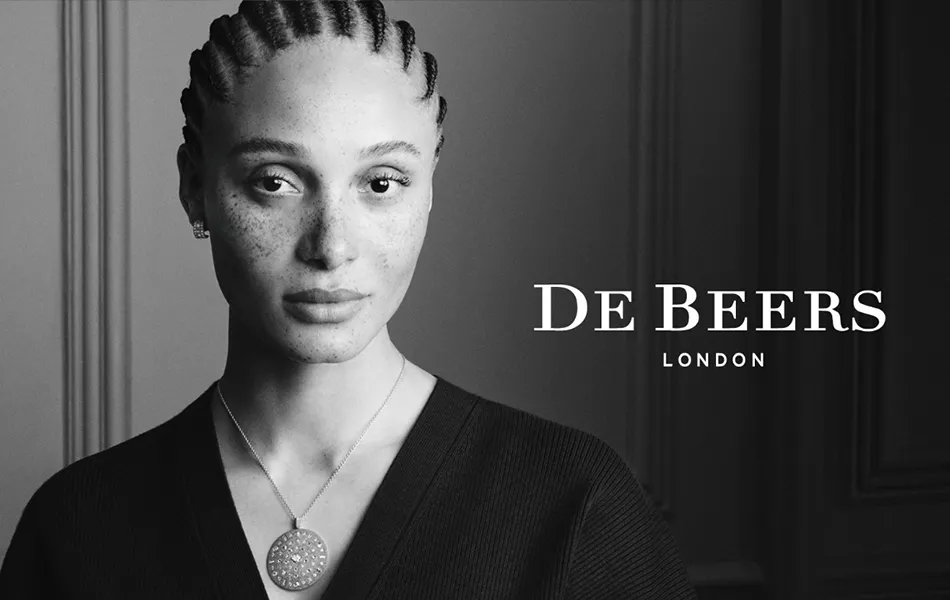
This week, De Beers London unveiled its new high jewellery collection, built around a cabochon cut that took five years to develop. Its chief executive, Emmanuelle Nodale, is very optimistic about the future De Beers London and confirmed that the brand is growing double digit.
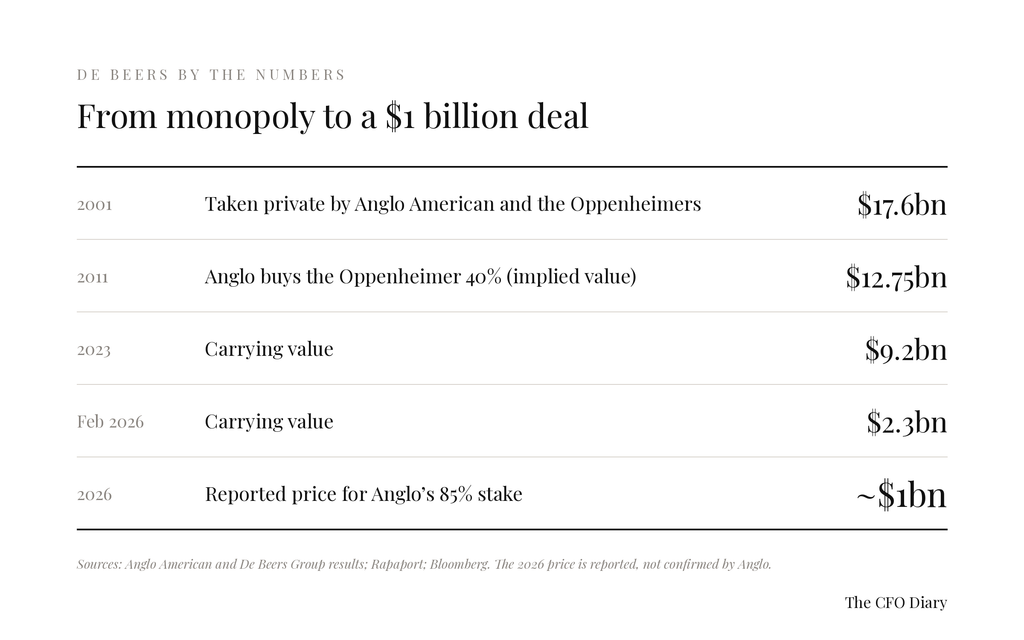
The reality behind the launch is less polished. Anglo American, which owns 85 percent of De Beers, is selling. Its preferred bidder is a consortium led by Gareth Penny, a former De Beers chief executive, and the reported price is about $1 billion. In 2011, when Anglo bought out the Oppenheimer family’s 40 percent, the whole company was valued at $12.75 billion. More than 90 percent
of that value is gone.
De Beers is one of the most famous names in luxury. In 1947 it gave the world A Diamond Is Forever, arguably the most successful marketing line ever written.
How does a century-old monopoly become a distressed deal?
For most of the twentieth century, upstream was the right place to be. De Beers controlled most of the world’s rough supply and set the price. Then the monopoly ended, and the margin moved to the people who owned the brands.
Over the same years, the brands on the other side of the chain did the opposite. Richemont’s jewellery houses, Cartier and Van Cleef & Arpels among them, made €5 billion of operating profit last year at a 30 percent margin. Cartier alone is estimated at around $12 billion of sales. De Beers Group lost more than 90 percent of its value, and De Beers the brand never scaled. It marketed the category, never itself. And its owners were miners, for whom the brand was never the priority.
The rise of lab-grown certainly hurt the industry. In 2024 De Beers told the Financial Times that around $4.5 billion of synthetic diamond sales had displaced roughly $7 billion of natural diamond sales in a single year.
But De Beers made it worse, with what may be its most costly strategic mistake. In 2018 it launched Lightbox, its own lab-grown line, at a flat $800 a carat, to cheapen the competitor. Instead it validated it. The most famous natural diamond name in the world was now selling synthetics and showing every consumer what they cost to make. It also blurred its own positioning: was De Beers the guardian of natural diamonds, or a seller of both? Then it shut Lightbox down. It validated its competition and confused its clients.
De Beers London was the attempt to fix this, and it is now changing hands with the rest of the group. For a buyer, it is a call option on a luxury maison. The $1 billion reflects the mine. The option comes free.
To value it, take Tiffany. LVMH paid $15.8 billion for it in 2021, about 3.6 times sales. At that multiple, De Beers London’s $250 million would be worth close to $900 million, almost the price of the whole group. An illustration, not a valuation. But it shows where the value could sit.
De Beers London has around 40 stores and roughly $250 million of revenue, according to diamond analyst Paul Zimnisky. Its chief executive, Emmanuelle Nodale, came from Kering’s Pomellato with a mandate to grow the brand, not just rename it. This is a retail strategy, not a showroom. Its Paris flagship sits on Rue de la Paix, across the street from Cartier. And it belongs to a group that owns the mines.
Getting there is another matter. Cartier sells around $12 billion a year. Tiffany needed LVMH’s balance sheet, new creative leadership and years of investment. A 40-store brand needs the same: freedom to create, capital to expand, and patience measured in decades.
None of that is what the buyer’s plan puts first.
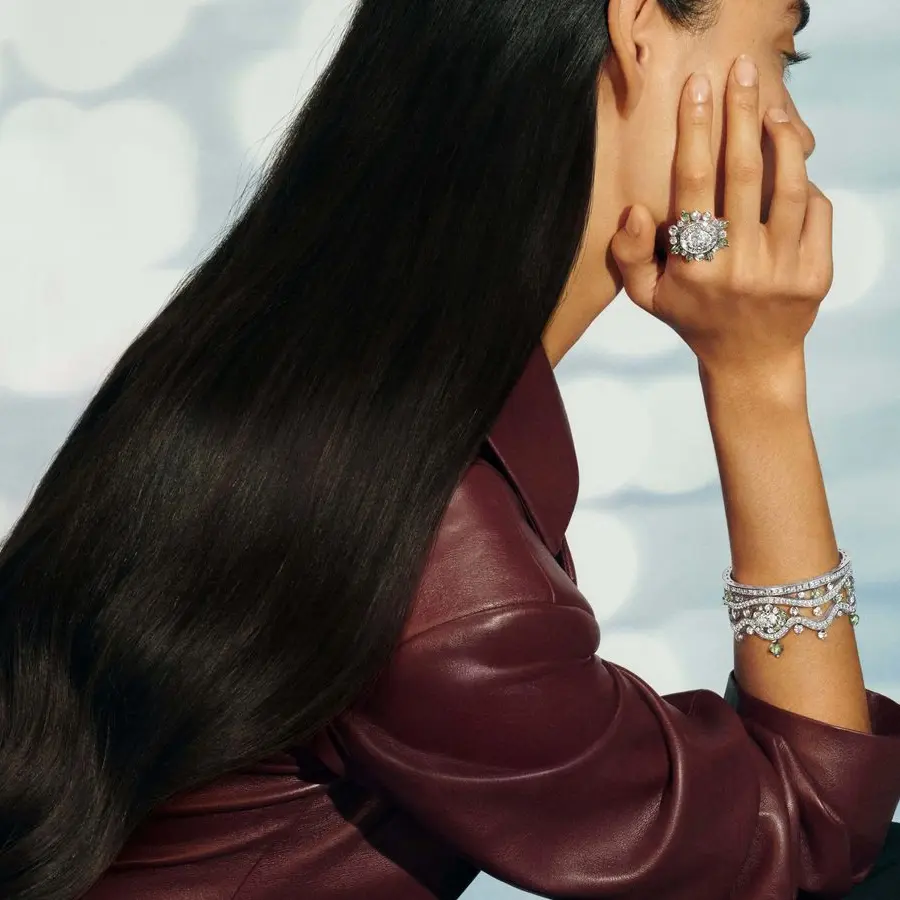
Image courtesy DeBeers
The planned $1 billion acquisition of De Beers by an industrial consortium (Gareth Penny, sovereign producer states, and midstream traders) creates a conflict of interest for its retail branch, De Beers London. Their business runs on volume. Diamonds have to come out of the ground to cover fixed costs, jobs and national budgets. A luxury group runs on the opposite logic. LVMH and Richemont make their money from brand equity, scarcity and pricing power. The stone is an input. The name is the asset.
Penny wants De Beers to become the steward of natural diamonds again, backed by $200 million to $300 million of marketing. That budget is for the category, not the retailer. It sells natural diamonds in general, including the ones Cartier and its peers. Nothing in the plan directs it to building De
Beers London.
This is where the brand can fail. Under this owner, De Beers London risks serving the mines rather than its clients: a shop window for natural diamonds, an outlet for the stones the group needs to sell, a voice for the category’s defence against lab-grown. Its message moves from desire to defence. A maison
cannot be built that way. The most successful jewellery Houses do not market against lab-diamond.
Cartier sells the Panthère. Tiffany sells the Blue Box. Bulgari sells the Serpenti. Van Cleef & Arpels sells the Alhambra. They sell desire and a story never the stone. Debeers had the most famous line in the business: A Diamond Is Forever. But it lent it to the whole category.
So the real question is this: what is De Beers London’s own story, when it sits inside a mine?
The brand can still work, if its owner funds it and leaves it alone. Two questions will decide it: how free De Beers London will be, and how much capital it will get to compete with its peers, or even to reach the 100 stores once promised.
Nothing in this buyer’s plan so far suggests either. In 2024, De Beers chief executive Al Cook told the Financial Times he wanted to build the world’s greatest jewellery maison, and that it would not be a natural part of a mining company. Yet it is being sold to one.
Sources: The Business of Fashion (interview with Emmanuelle Nodale; Paul Zimnisky estimates); Financial Times (Al Cook, 2024); Anglo American and De Beers Group 2025 results; Richemont results, year to March 2026; LVMH and Tiffany & Co. filings; JCK (Gareth Penny at CIBJO); Bloomberg and Rapaport (preferred bidder and reported price).
 Capital Couture
Five years of cultural momentum, zero euros in profit. The house has no creative director, no...
Capital Couture
From London to Dubai, the queues looked the same: infinite. A scene the industry had quietly...
 Capital Couture
At the Vogue Business Summit, the regions luxury files under future demand were talking like builders....


No comments yet.