


Five years of cultural momentum, zero euros in profit. The house has no creative director, no runway show, and two product icons holding up both the brand DNA and the revenue. With a statutory deadline now looming, Alaïa’s revival faces its real moment of truth.
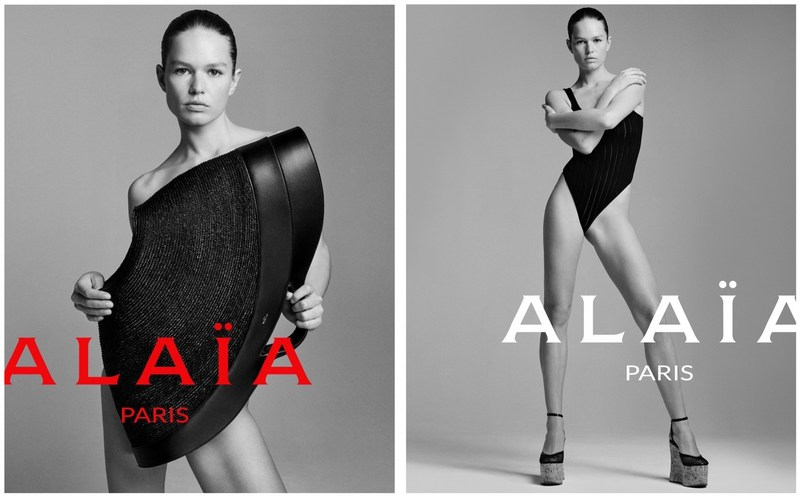
image courtesy of ALAIA campaign
In October, during the Paris Spring/Summer 2027 season, Alaïa will hold a presentation. Not a show. Eight months on, no successor has been named since Pieter Mulier announced his departure in January and showed his final collection in March.
This is the second time Richemont has struggled to find the right creative director for Alaïa. In 2017, after Azzedine Alaïa passed away, it took the group three years to appoint a successor and four to put a collection back on the runway. Four years of mourning, where the brand lived on re-editions and Azzedine’s archives. Yes, it survived but it barely grew.
When Mulier stepped down as creative director of Maison Alaïa in January 2026, he left behind a brand that had arguably captured the cultural zeitgeist more than any other heritage label in Paris. Over his five-year tenure, he achieved what many considered impossible: he revived the soul of the late Azzedine Alaïa while creating massive, viral commercial hits. From the mesh ballerina flats on every fashionista’s feet to the ubiquitous Teckel bag, Alaïa’s momentum was palpable. By late 2025, the brand had climbed to fifth place on the Lyst Index of the world’s most desirable brands.
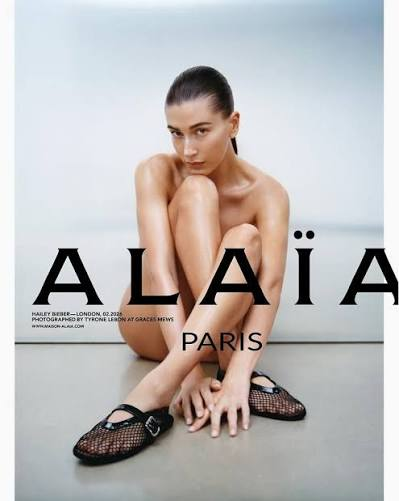
image courtesy of Alaia
Yet that momentum did not land on the bottom line. Behind the acclaimed shows and the viral products, a starkly different reality was unfolding on the corporate ledgers.
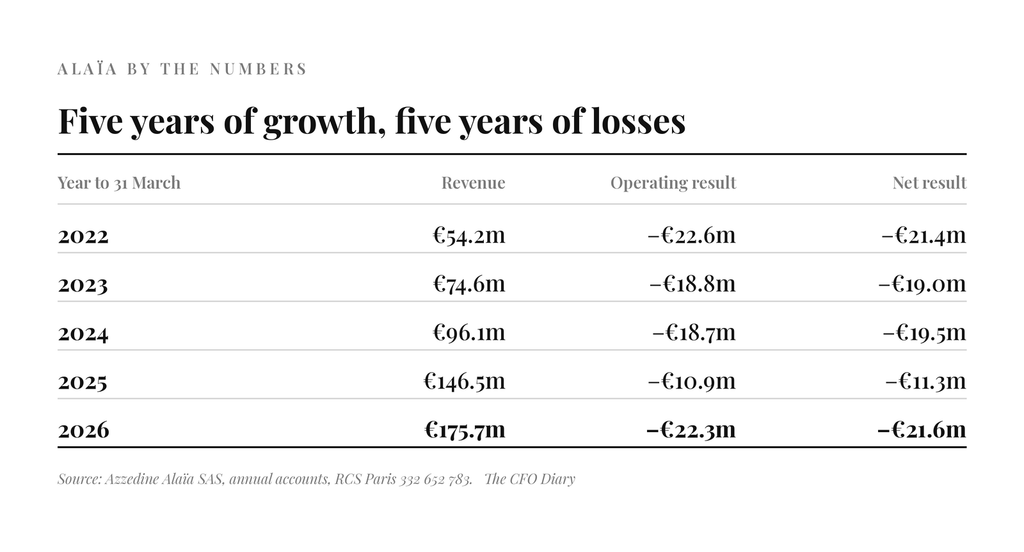
Azzedine Alaïa SAS, annual accounts, RCS Paris 332 652 783. The company sells three-quarters of its goods outside France. Richemont does not publish a consolidated result for the house. Numbers are for the main operating company Azzedine Alaïa SAS.
The answer sits in one line of the accounts. Under Richemont, Alaïa staged an expensive comeback: a retail expansion to around twenty freestanding boutiques, a brand-new flagship on Rue du Faubourg Saint-Honoré, and the runway productions that made the house famous again. All of it lands in external purchases and services: rent, logistics, marketing, shows, consultants. That line reached €118.3 million last year against €175.7 million of revenue. Sixty-seven cents in every euro. It rose €40.4 million while revenue rose €29.1 million.
Growth is not fixing this house. It is making it more expensive. Mulier moved Alaïa from archive-dependent to loss-making with momentum and momentum, it turns out, costs more than the archive did.
Alaïa’s identity is also part of the equation. The brand DNA is intrinsically tied to scarcity and meticulous construction. It cannot be mass-produced without destroying its prestige. So, while accessories like the ballet flats provide a high-margin cushion, they have never been enough to carry the cost of running a house at this level of ambition.
The losses now carry a legal consequence. In March 2024, Richemont raised Alaïa’s share capital from €250,000 to €75.25 million, five days before a year-end that would otherwise have closed with negative equity. Within twelve months, accumulated losses had pushed equity back below half of that capital. In July 2026, for the second consecutive year, the sole shareholder formally acknowledged it — the threshold at which French law obliges an owner to choose between dissolving a company and continuing it. Richemont chose continuation.
But the choice comes with a deadline: by the financial year ending March 2028, the group must either restore the equity or reduce the share capital to absorb the losses. Of the €75.25 million committed in 2024, €61 million has already gone. Whoever takes the creative director job inherits that clock as well as the archive.
Richemont has owned Alaïa for nineteen years and has never made money from it. It bought into a house turning over €13 million in 2007. Revenue is now thirteen times that, and the business has still never earned its capital.
what nineteen years of ownership have actually bought? A house recapitalised by €75 million and back below the statutory threshold within a year, now running on two accessories and no creative director.
The uncomfortable answer may be that the arithmetic of an archive house is simply incompatible with quarterly disclosure. A house of this kind needs more than patience and capital because Richemont has supplied both. It needs conviction that shows up as a plan. There is no evidence of a decade-long strategy, only a sequence of reactions.
This is why the successful buyers of these heritage assets are almost always private. Diego Della Valle bought Schiaparelli in 2006 through his personal holding, deliberately outside listed Tod’s. Renzo Rosso’s OTB did it with Maison Margiela and Jil Sander. Mayhoola did it with Valentino and Balmain.
So, how long can Alaïa afford the void?
Longer than it should have to. Richemont can carry this house indefinitely, €96 million of divisional losses barely register against €8.5 billion of net cash. That is the problem.
The void at Alaïa was never the empty chair. A designer can be hired in a season. The void is the absence of a decision about what this house is for, and on that, the deadline is March 2028.
 Capital Couture
From London to Dubai, the queues looked the same: infinite. A scene the industry had quietly...
 Capital Couture
At the Vogue Business Summit, the regions luxury files under future demand were talking like builders....
 Capital Couture
At nearly 16x EBITDA, the deal is not just about restaurant margins. It is about owning...


No comments yet.