


After Japan and the US courts ruled the Royal Oak shape isn’t legally distinctive, Audemars Piguet stopped suing imitators. It started dictating the rules of the game.
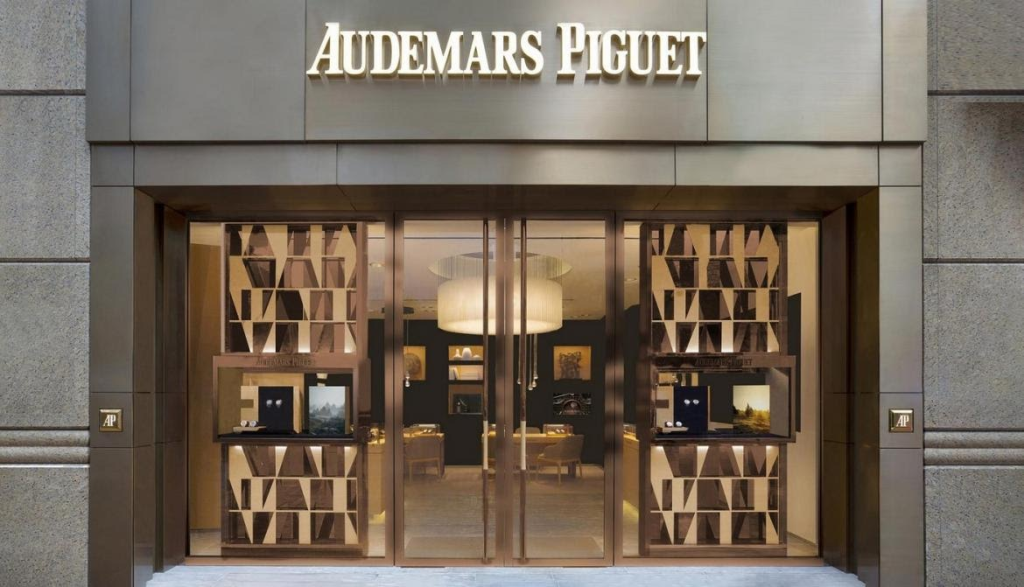
The rumour is confirmed. Audemars Piguet and Swatch will launch the Royal Pop on May 16th, and the news has split the watch world. Some call it the democratization of luxury. Others say AP is gutting its own brand equity. Both takes miss the point.
This is the most disciplined risk management move in luxury watchmaking this decade. And it has almost nothing to do with the Royal Oak itself. It has everything to do with the octagonal bezel, eight hexagonal screws and tapisserie dial that AP could no longer legally call its own.
In 1971, Audemars Piguet briefed designer Gérald Genta to create a luxury steel sports watch for the Italian market. He delivered the sketch overnight, taking traditional diving helmets as his inspiration. The result was a wide, octagonal bezel with eight hexagonal screws that resembled a ship’s porthole. The Royal Oak launched at Baselworld 1972 in stainless steel at a price above gold dress watches. Retailers refused to stock it. Collectors were confused. It nearly destroyed the company.
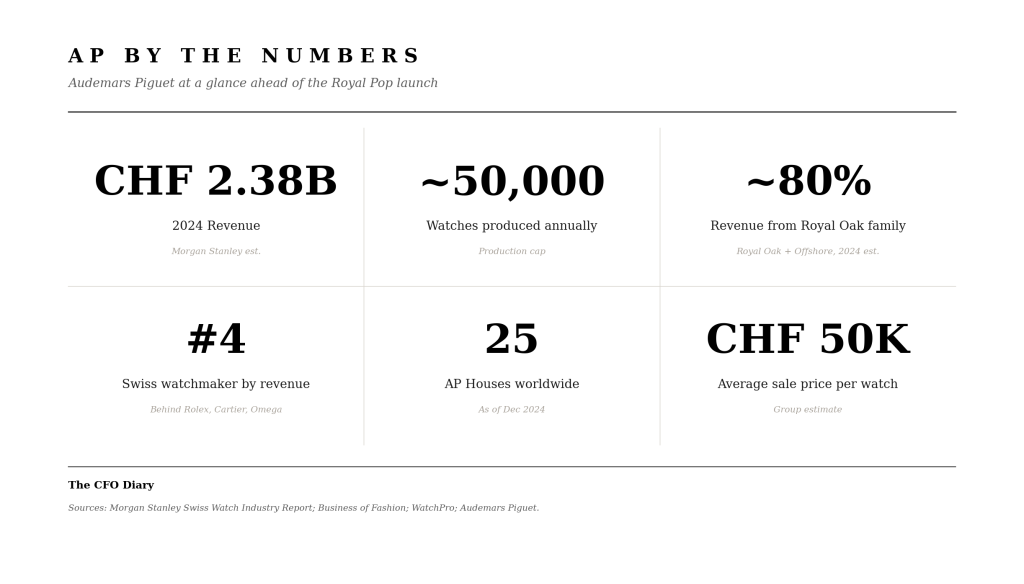
Five decades later, around 80% of AP’s 2022 revenue came from the Royal Oak. Genta went on to design the Patek Philippe Nautilus, the IWC Ingenieur and the Bulgari Bulgari. The Royal Oak made AP a confirmed member of the Holy Trinity alongside Patek Philippe and Vacheron Constantin, and the fourth-largest Swiss watchmaker by revenue, producing only an estimated 50,000 timepieces annually.
AP became a Luxury icon and the octagonal silhouette is icon’s signature. Distinctive enough you thought? Not so sure.
In March 2024, the Japan IP High Court dismissed AP’s appeal to register the Royal Oak shape as a 3D trademark for lack of both inherent and acquired distinctiveness. In January 2025, the US Trademark Trial and Appeal Board affirmed the USPTO’s refusal to register two trademarks covering the round watch face, octagonal bezel with eight hexagonal screws, and Grande Tapisserie pattern, finding the designs functional and inherently non-distinctive.
Two of the largest watch markets in the world had effectively told AP: the shape isn’t yours to defend.
the timeline matters: Swatch filed the Royal Pop trademark in Switzerland on January 15, 2024, two months BEFORE AP lost in Japan. They filed in the US on June 18, 2024, six months before the US TTAB ruling. The mark was registered in the US on December 17, 2024, two weeks before AP’s American defeat was finalised. This is not a brand reacting to defeat. This is a brand that saw the verdict coming and built the commercial response while the judges were still debating.
Picking Swatch was not random either. The 2022 MoonSwatch with Omega sold over 1 million watches in its first year, and tripled Swatch brand turnover to CHF 660 million in 2023. Swatch Group also accounts for roughly 70% of total Swiss watch industry output by volume. No other partner on earth has the manufacturing capacity or the retail footprint to flood every major city on the same Saturday. AP did not pilot the idea. They bought a proven playbook.
The financial mechanism is clean. AP cannot stop a imitators from making an octagonal-bezel watch with eight screws but they can guarantee that when a Gen Z buyer thinks “octagonal sports watch with screws,” the first one they own is officially co-signed by Le Brassus. Customer acquisition cost on that future Royal Oak owner goes to zero. Swatch pre-qualifies them at sub-$500.
The timing also helps a brand that needs a cultural reset. In Q2 2025, AP secondary market prices dropped below retail for the first time since 2022, with prices declining faster than its big-three peers. Morgan Stanley research has also flagged that the age of AP inventory on the secondary market is currently towards historical highs, suggesting prices have further to fall, particularly for its most-traded Royal Oak. Royal Oak entry prices at retail hover around $30,000, and AP has been ceding cultural relevance to more accessible names like Rolex, Cartier and Omega among younger buyers.
On May 16th, queues will form outside every participating Swatch boutique. Free global media. Free positioning. Audemars Piguet is back in the cultural conversation without paying for the campaign.
The Royal Pop isn’t really a watch launch. It is the end of an era in luxury IP.
The legal framework that defeated AP applies to every heritage code in mechanical watchmaking. The Patek Philippe Nautilus (also Genta), the Cartier Tank, the Jaeger-LeCoultre Reverso, the Rolex Submariner. All built on silhouettes that courts increasingly classify as functional rather than distinctive.
The Genta archive alone is a contagion vector. Royal Oak, Nautilus, IWC Ingenieur, Bulgari Bulgari. Four icons. Same designer. Same legal exposure.
The brands with the deepest waiting lists today are the ones most legally exposed tomorrow.
Audemars Piguet isn’t giving up the Royal Oak. They are giving up a fight the courts already ruled they couldn’t win. The shape is not distinctive. The brand is. And the brand stays inside Le Brassus.
The cultural ownership of the octagonal silhouette gets reasserted on AP’s terms instead of ceded to copyists they cannot legally stop. The paradox is brutal. Heritage codes become legally distinctive only when consumers attribute them to a single source. The more they get copied, the more that attribution erodes.
To my fellow AP owners: don’t worry. The Oak will always be Royal!
Sources



 Fashion Office
This week, LuxExperience’s shares jumped as much as 24% on its results. Group CEO Michael Kliger...
 Fashion Office
FT Luxury Summit with Elizabeth Paton and Cedric Charbit The most desirable house in fashion posted...
 Fashion Office
Chantilly 12.05.2026 C.F.O :Capital Fahion and Opinion Six panels. Four pillars of the luxury growth model...



No comments yet.