


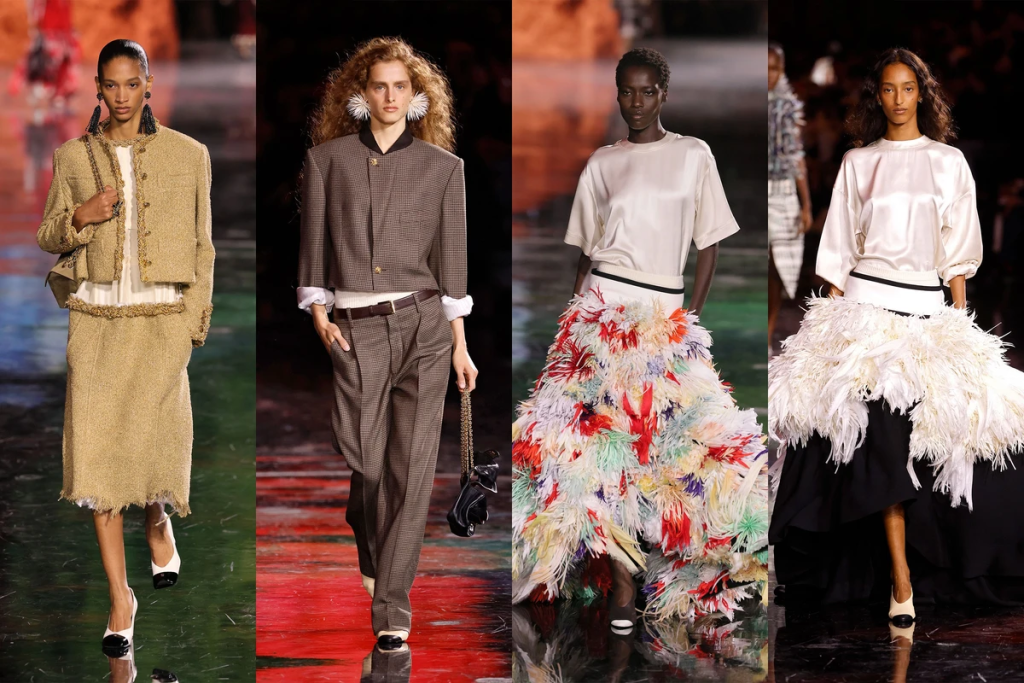
Chanel Spring/Summer 2026
The luxury industry arrived at the end of 2025 with an unprecedented storyline and challenges: creative directors rotating through musical chairs, marketing budgets inflating beyond reason, campaigns growing louder — yet the numbers remain lower than they should. Onequestion hangs in the air: is the spectacle enough to bring consumers back?
The latest Bain & Altagamma report shows that the global market for personal luxury goods is down about 2% (with a forecast 2025 value of €358B vs. €369B in 2023 and €364B in 2024). More concerning: the number of luxury consumers has dropped from 400 million in 2022 to around 340 million in 2025.
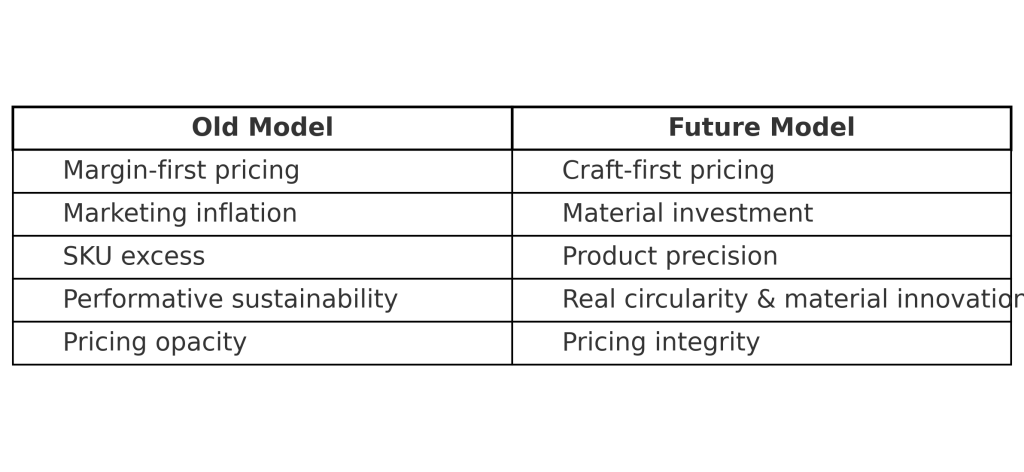
The luxury slowdown isn’t only caused by macroeconomics — it’s caused by mispriced trust.
What pushed consumers away these past few years wasn’t a lack of creativity (or at least not only that) but the collapse of the price–craft–value equilibrium.
Luxury’s biggest crisis isn’t demand — it’s credibility. Therefore, the next battleground for luxury isn’t only creativity or retail square meters — it’s pricing discipline.
Consumers did not reject the Dior Bar Jacket. They did not revolt against Chanel’s 2.55. They walked away because the numbers stopped making sense. Luxury fatigue isn’t aesthetic — it’s rational. We are paying more for less.
The fastest-growing luxury segment is resale, not retail — which is the clearest referendum on the price–value disconnect.
Most brands tested extreme price frontiers until the system finally broke — and they received pushback, not only from aspirational but also from their most loyal and wealthy customers. Aspirational buyers, once the growth engine of the industry, have become collateral damage: their value contribution fell from ~74% of market spend in 2013 to ~61% in 2024. Meanwhile, brands increasingly depend on VICs — barely 2% of the customer base yet responsible for nearly 45% of total luxury sales — creating fragility, reducing generational renewal, and shrinking the base that once fuelled desire. VIC and UNHWI are more resilient to those price hikes yes! but are now signalling fatigue, shifting toward houses that respect the value–price–craft triangle.
After years of inflationary drift, the consumer has reached a simple conclusion: the promise of luxury and the reality of the product no longer match. Scarcity was manufactured, not crafted. Celebrity replaced substance. Sustainability turned into PR instead of practice.
The real problem is that luxury Houses became financial products before they remained cultural ones. The shift from creative stewardship to quarterly earnings is what distorted pricing logic.
Consumers tolerated it for a while because the dream was still intact — until it wasn’t. The crack wasn’t created by austerity but by discrepancy. Vogue Business’ recent survey confirms the shift: “luxury no longer means quality,” and more than half of shoppers believe prices should come down rather than climb higher. Yet in the latest BoF State of Fashion report, 75% of brand executives still plan to raise prices in 2026.
Luxury’s biggest mistake was assuming consumers would accept price hikes indefinitely. The customer of today is not intimidated — they are informed. When numbers stopped making sense, they walked away— to pre-loved, to mid-luxury, or to minimalism. Not because they don’t love luxury, but because brands stopped creating value for them.
They don’t need more ways to buy — they need a better reason to buy. And fewer brands are offering it.
Best in class: Hermès remains the clearest proof that discipline still wins. No inflationary shortcuts, no forced novelty — just consistency, craft, and controlled growth. When you anchor your brand on integrity rather than noise, you do not need to chase the customer. They come back on their own.
No Maison can walk back the price of its icons. Chanel will never announce: “The 2.55 is €6,000 again.”
But they can restore credibility through new entry heroes — priced rationally instead of greedily.
The new Chanel 25, which quickly became a hero bag, costs around €5,800, far below the Classic Flap, which now sits near €10,000.
Dior followed the same pattern with the Dior Toujours, priced around €3,500, much closer to the price logic that existed before the multiple price hikes — another quiet correction back to a world where craftsmanship and numbers still share the same rationale.
Dior Toujours Bag. (Buy here https://www.dior.com/en_ae/fashion/womens-fashion/bags/handbags)
Luxury Houses must understand that price is no longer just a number, its a promise.
If you dare to ask for more, you must show more: in craft, in material, in longevity, in rarity.
The upcoming creative-director resets offer another chance to rebalance integrity and product truth. New designers may bring new aesthetics — but will they bring new price logic? This is the moment to rebuild loyalty by aligning product truth with product price.
Luxury is at a crossroads: raise prices again without delivering equivalent value, and the risk is total rejection.
Luxury was built on the relationship between craft and emotion. It will be rebuilt on the relationship between price and integrity.
Those who keep chasing vanity pricing will lose relevance. Those who return to value creation will define the next era.
With Style and Strategy,
Kahina L.



 Fashion Office
Source: Vogue Arabia x Qatari Diar in Egypt As we enter 2026, luxury fashion is not...
Fashion Office
Source: Brunello Cucinelli Dubai Fashion Show Spring 25 For a decade, the industry confused expansion with...
Fashion Office
Image :Riyadh Fashion Week Stella McCartney Luxury’s power map is being redrawn. While Europe, the US...




No comments yet.