


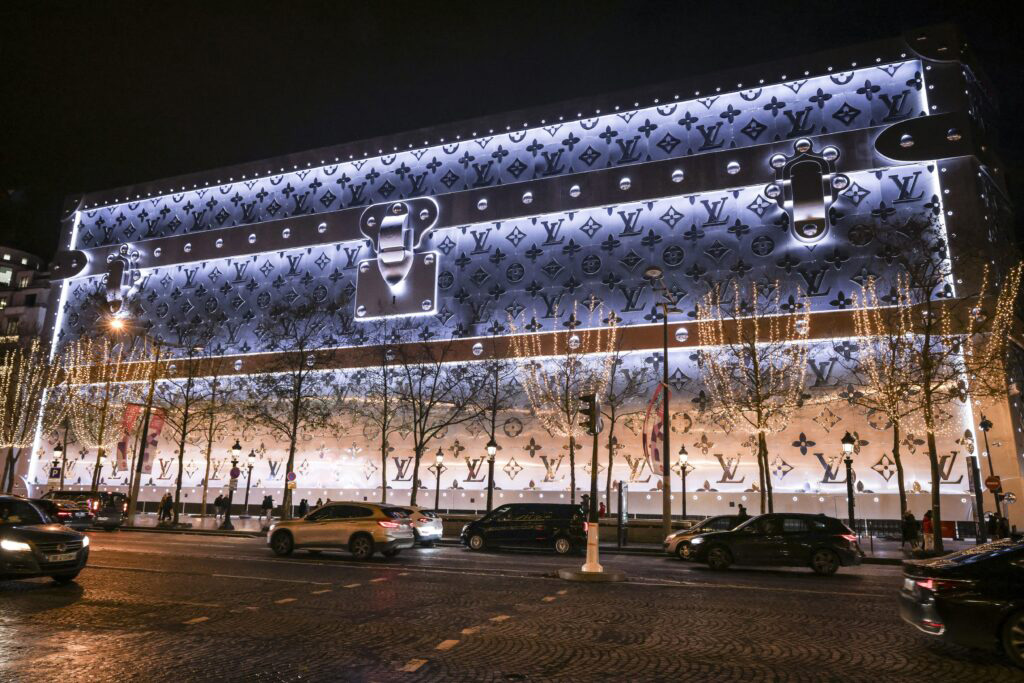
When LVMH acquired Cap Estel in August — a Riviera jewel perched between Nice and Monaco for roughly €200 million — the move was widely praised as validation of its hospitality and legacy strategy.
But applause is premature. Because the real test for Arnault’s vision isn’t in Cap Estel or Belmond. It’s in turning Louis Vuitton into a hotel brand — where the Maison doesn’t just own (established) hotels but becomes one.
LVMH’s hotel acquisitions thus far have remained operationally separate. Belmond stays “Belmond,” Cheval Blanc retains its identity. These moves diversify a portfolio and anchor prime real estate, but they don’t materially alter how clients perceive Louis Vuitton itself.
The Louis Vuitton Hotel, slated for 103 Champs-Élysées (2026), changes the game: this is a Maison turned destination. For the first time, the logo over the door will match the luggage guests carry. The brand becomes immersive — not a sponsor of experience but the experience.
That makes this project exponentially riskier. A hotel must deliver ambiance, service, narrative, and operational excellence — every hour, every night. If one of those threads unravels, it damages brand equity, not just revenue.
This isn’t another real estate spree; it’s a strategy for the next cycle.
The timing speaks for itself. In 2024, the personal luxury goods market dipped by about 2 percent to €363 billion, its first contraction outside the Covid years.¹ Forecasts for 2025 point to another 2–5 percent decline.²
Even LVMH, the industry’s bellwether, reported a challenging first half of 2025, with revenues down 4 percent and profits plunging 22 percent, largely dragged by its flagship Fashion & Leather Goods division (Forbes). In Q3 2025, LVMH posted a 1 percent increase in revenue, though leather goods slipped 2 percent — a performance that reflects the group’s uneven recovery and growing focus on categories beyond fashion.
At the same time, spending patterns are shifting. Consumers are redirecting money from products to experiences — travel, hospitality, and curated events — seeking value in memory rather than material.³ For Arnault, that makes hospitality not a side business but the logical strategic hedge against a maturing market: when ownership slows, experience becomes the growth engine.
“That behavioral pivot explains why LVMH’s next frontier isn’t couture — it’s a reception Desk”
Cap Estel, Belmond, Cheval Blanc — it’s diversification. But the Vuitton Hotel is a different species: vertical diversification pushed to the limit — where diversification becomes identity, and identity becomes legacy.
This is where the narrative flips. From “LVMH owns hotels” to “Louis Vuitton is the hotel.” The experiment shifts from portfolio strength to brand architecture. For years, luxury houses spoke of a “brand world.” This is the literal version: architecture, services, scents, sensory cues — the house as ecosystem.
Hospitality is capital-intensive, lower-margin, and slow to pay back — the anti-handbag playbook. Yet it compounds something goods alone cannot: memory. Each night under the LV monogram is a memory deposit that reinforces pricing power and loyalty over decades.
Arnault’s organization has long framed luxury as the business of creating desire; the hotel extends that logic from boutique to 24/7 lived experience. Versace, Armani, and Bulgari ventured into branded hotels — via operators (Marriott / Emaar). But here Vuitton’s project is in-house: ownership, concept, and operations within the LVMH ecosystem.
It’s not just a business gamble. The reputational upside is massive — but so is the downside:
• Overreach risk: a single service miss becomes a brand-level headline.
• Internal tension: if an LV-branded flagship eclipses Cheval Blanc or Belmond, brand politics emerge over capital allocation and halo priority — manageable, but real.
• Brand Narrative fragility: A weak LV hotel would scar the story more deeply than a seasonal fashion misstep. And the branded-hospitality playbook is already littered with cautionary tales — from half-empty designer resorts to mismanaged partnerships that blurred more logos than they built.
History has already tested this playbook — often with painful results. Hotel Missoni Edinburgh collapsed after its licensee went bankrupt in 2014, proving that luxury can’t be outsourced. Palazzo Versace Dubai, once valued near AED 1.3 billion, was auctioned for just AED 600 million, a reminder that a logo alone can’t carry a hotel.
Cap Estel, Belmond, Fontenille are portfolio diversification. The Louis Vuitton Hotel means brand sovereignety. And unlike many of his predecessors in fashion hospitality, Bernard Arnault isn’t licensing the Louis Vuitton name — he’s building it fully in-house. No franchising, no co-branding, no shortcuts. That level of capital control and creative ownership may be the real secret to branded hospitality.
For over a century, Louis Vuitton sold the romance of travel. In 2026, it will sell the journey itself — adding a low-margin, capital-intensive business to sustain a high-margin legacy. It’s a bold but measured move.
In CFO terms, it’s brand compounding — making emotion a Tangible Asset.
If Arnault succeeds, he will make the impossible possible: giving desire a physical address.
With Style and Strategy,
Kahina.
Footnotes
¹ Bain & Company – Luxury Goods Worldwide Market Study (Fall 2024 Update)
² Bain/Altagamma and McKinsey FashionScope Forecast 2025
³ BCG x Altagamma “True-Luxury Global Consumer Insight 2024”
⁴ Reuters – LVMH Q3 2025 Results: Luxury Giant Shows 1% Sales Rise as Leather Goods Fall 2% (October 2025)




 Brand Focus
Image credit: Balmain When Olivier Rousteing took over Balmain in 2011, he was just 25 years...
Fashion Office
Why Luxury’s Next Big Price Move Will Make or Break Brands? Chanel Spring/Summer 2026 The luxury...
Fashion Office
Source: Vogue Arabia x Qatari Diar in Egypt As we enter 2026, luxury fashion is not...




No comments yet.