


Image credit: Balmain
When Olivier Rousteing took over Balmain in 2011, he was just 25 years old, barely known outside fashion circles, and stepping into a house that was, in truth, near bankruptcy.
Annual revenues hovered around €30 million, with more than half coming from licensing rather than directly owned business.
The archives were dusty, the couture clients long gone, and the brand — despite Christophe Decarnin’s glitter-rock moment — remained niche.
Fourteen years later, Rousteing exits leaving behind a company estimated at €300 million in annual sales and operating over 50 boutiques worldwide — a turnaround accelerated after Qatar’s Mayhoola for Investments acquired the brand in 2016.
The revival stands as one of fashion’s rare modern miracles: a small heritage label turned into a global luxury powerhouse.
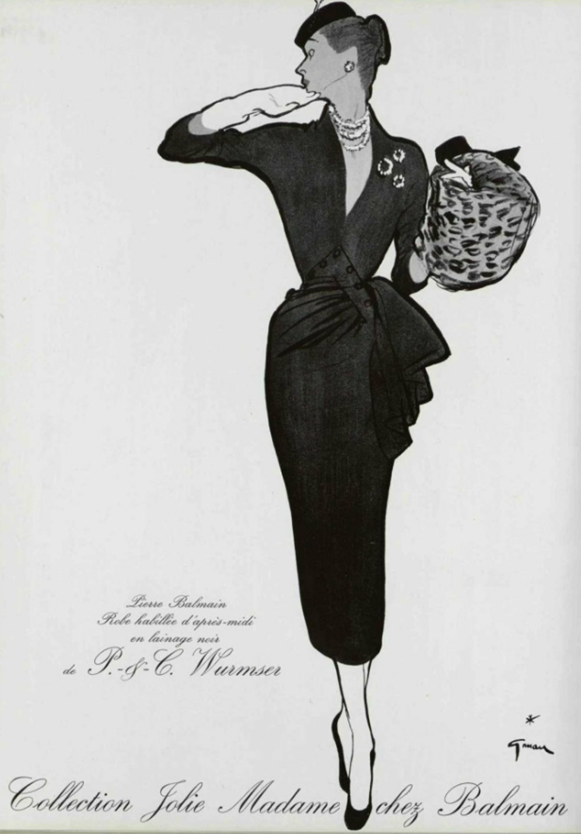
Rousteing inherited the sharp-shouldered silhouettes and decadent DNA of Decarnin, his predecessor. Yet he also paid tribute to Pierre Balmain, who founded the label in 1945.
He preserved the house’s key aesthetic codes: architectural structure, rich ornamentation, and especially the iconic “Jolie Madame” silhouette — Balmain’s signature hourglass shape combining elegance with daring femininity.
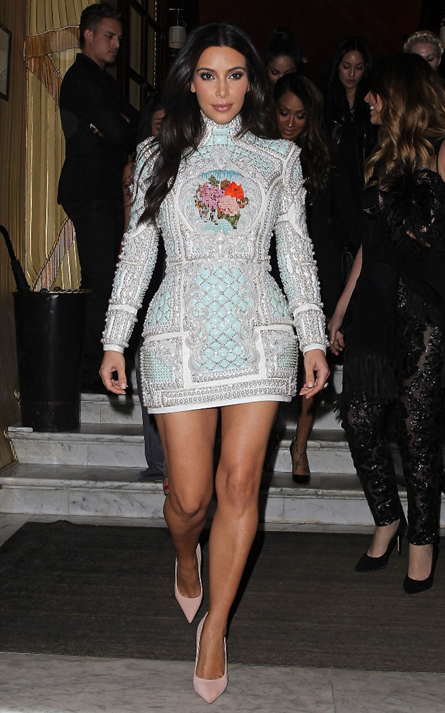
He made Balmain instantly recognisable without the need for a logo: military jackets, power shoulders, corseted waists, and high-voltage embellishment.
He also spotted the future before anyone else — celebrity as currency.
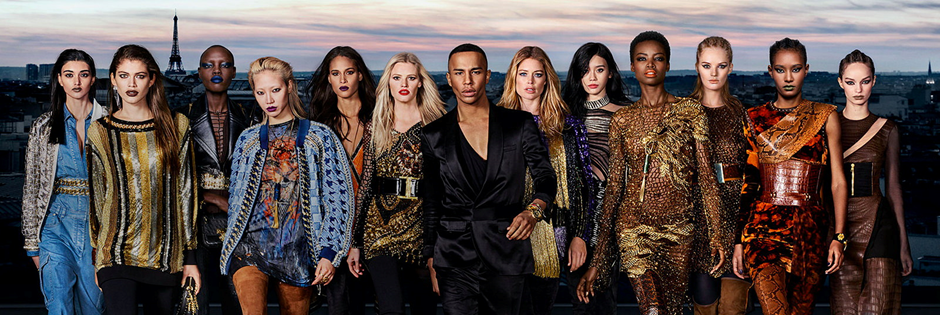
Rousteing created the Balmain Army — a coalition of stars and supermodels from Kim Kardashian to Rihanna, Beyoncé, and the Hadid sisters. Each embodied the “Jolie Madame” , reimagined for the modern era.
They didn’t just wear Balmain; they became part of its story.
The H&M x Balmain collaboration in 2015 cemented the brand’s cultural takeover, selling out in minutes and crashing servers worldwide.
Behind the flash was strategy. Under CEO Emmanuel Diemoz, Balmain posted roughly 25% annual growth between 2013 and 2015 — proof that the attention economy could translate into real sales.
Mayhoola’s €500 million acquisition in 2016 provided the capital to scale retail and product lines — the SoHo flagship (100 Wooster Street) opened in April 2016, followed by the Paris flagship (374 Rue Saint-Honoré) in February 2019 — alongside a full accessories rollout, the revival of Balmain Couture in 2019, and the launch of Balmain Beauty.
By 2019, revenues had likely quadrupled versus 2015.
By 2025, they sit near €300 million — ten times Rousteing’s starting point.
Most remarkably, unlike peers such as Chanel or Louis Vuitton, where leather goods form the core of the revenue engine, Balmain’s modern growth was built largely on ready-to-wear — rare in luxury, where profitability usually depends on an iconic bag.
(Note: While Balmain’s category split isn’t publicly disclosed, industry commentary supports that its scale came primarily from ready-to-wear rather than accessories.)
His leadership wasn’t just aesthetic; it was cultural.
As one of the few Black creative directors in Paris, he redefined the wardrobes of powerful women and built an entire generation of Balmain soldiers.
Power had a uniform — and Balmain designed it.
He mastered the art of blending luxury couture with pop culture, redefining how fashion engaged with fame, music, and the modern audience.
His own persona became part of the brand’s differentiation in an industry that had long sidelined diversity.
He made inclusion aspirational, not impossible.
But success built on personality creates its own risk.
Today, Balmain is Olivier Rousteing, and Olivier Rousteing is Balmain.
As he steps down, the brand faces a succession dilemma. Whoever follows must navigate two opposing imperatives:
For Rousteing himself, the challenge flips: to rebrand himself beyond the house that defined him.
His next chapter will reveal how his creative vision evolves beyond the house he resurrected.
1. Build a Distinctive Look, Not a Logo
Rousteing made Balmain recognisable without a single monogram.
Silhouette became the logo. Precision became the brand code.
2. End Licensing Dependency and Scale Direct-to-Consumer
Balmain’s revival began when it brought control back in-house.
Revenue means little if profit and image sit elsewhere.
3. Leverage Culture and Digital to Monetise Visibility
Balmain didn’t just sell dresses — it built an ecosystem of content, celebrity, and community.
Shows transformed into media events, campaigns into global social moments, and the Balmain Army amplified reach far beyond traditional luxury.
Olivier Rousteing closes his chapter at Balmain with one of his gowns displayed in the Louvre earlier this year —a symbolic farewell from a designer who spent fourteen years turning Parisian couture into a global language.
It’s not just an exit; it’s a legacy woven into the history of French fashion.
With Style and Strategy,
Kahina


 Brand Focus
As LVMH turns Louis Vuitton into a hotel, the Maison’s legacy meets its riskiest experiment yet....
Fashion Office
Source: Brunello Cucinelli Dubai Fashion Show Spring 25 For a decade, the industry confused expansion with...
Fashion Office
Image :Riyadh Fashion Week Stella McCartney Luxury’s power map is being redrawn. While Europe, the US...






No comments yet.