


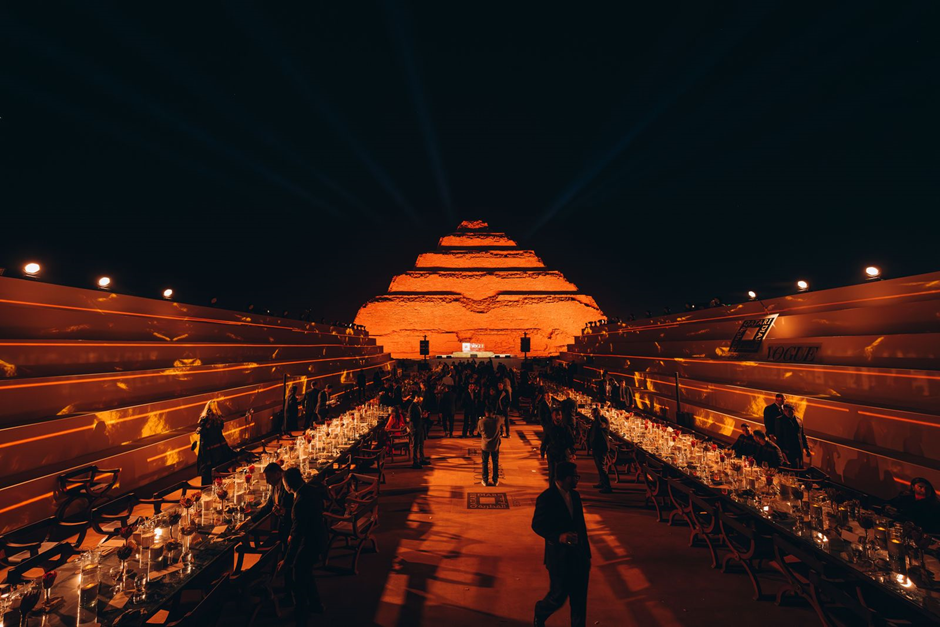
Image :Riyadh Fashion Week Stella McCartney
Luxury’s power map is being redrawn. While Europe, the US and China struggle with demand softness and price fatigue, the Gulf region is not simply holding ground — it is setting the pace. In 2024, the GCC personal-luxury market reached US $12.8 billion, with growth of approximately 6% year-on-year, even as global personal-luxury spending contracted by roughly 2%.¹ The region currently accounts for about 6% of global luxury consumption, yet its momentum places it among the fastest-growing luxury markets worldwide. In an industry facing structural headwinds, resilience is more consequential than scale.
What is unfolding is not a rebound. It is a power shift. The Gulf is no longer solely a destination of luxury consumption. It is actively shaping distribution, experience, talent and strategy. Brands opening stores here are not simply expanding — they are engaging in a new playbook where cultural capital, infrastructure and strategic partnerships matter as much as product. The Gulf has moved from consumer to power base for global luxury.
Distribution and luxury retail economics have always been a structural strength of the Gulf, today that system is scaling to meet both international and local demand . The whole region is attracting premier brand flagships and, more importantly, offering infrastructure where global luxury can test, learn and scale. For 70 years, the Chalhoub Group has enabled iconic luxury brands to launch full-service stores in the Gulf while also operating its own flagship retail concepts such as Level Shoes.
According to Alpen Capital, GCC retail sales are projected to grow from US $309.6 billion in 2023 to US $386.9 billion in 2028, a CAGR of ~4.6%. This growth is translating directly into physical demand for prime retail space. The region’s luxury real estate is constrained, and premium storefronts are sold out in many major developments.³
Major mall projects such as Qatar’s Place Vendôme illustrate this shift: a US $1.3 billion luxury mall launched in 2022 with flagship store openings from brands that historically limited Gulf presence.⁴ Meanwhile, Saudi Arabia and the UAE are rolling out new retail-led tourism zones where VAT advantages, regulatory agility and tax incentives accelerate deployment. In April of this Year, Majid Al Futtaim announced AED 5 billion transformation of Mall of Emirates with focus on retail experience, lifestyle and wellness. The goal is not simply to add a retail destination, but to forge a cultural anchor and community hub.
Khalifa Bin Braik, Chief Executive Officer of Majid Al Futtaim Asset Management, said: “Two decades ago, Mall of the Emirates set a new benchmark for retail and entertainment in the region. Today, we’re building on that legacy with a bold investment that redefines what a mall can be. This transformation goes beyond physical expansion — it’s about creating new ways for people to connect, unwind, and be inspired, all in one destination.”
The competitive edge is speed and capital: projects that take years elsewhere move with remarkable agility in the Gulf. For instance, in Dubai, companies in key free zones can obtain a commercial licence within a day or even minutes, compared with multi-month set-ups in European capitals.
The Gulf is offering brands both access to affluent clientele and a high-performance retail macro-environment.
In effect, the region is not just consuming luxury — it is hosting and directing it. Partnerships between brand principals, local conglomerates and developers are now central to luxury strategy: co-ownership, curated experiences, region-specific roll-outs. The centre of gravity for luxury and retail in general is no longer confined to Paris or Milan — it is expanding to Riyadh, Dubai and Doha.
Strategic scale-up in the Gulf is also built on talent and culture, not just retail square footage. Under Saudi Arabia’s Vision 2030, fashion, culture and hospitality are elevated to strategic industries.⁵ The Saudi Fashion Commission reports the fashion sector’s contribution to GDP rose to 2.5% from 1.4% in 2021–22.⁶ The newly announced Riyadh School of Arts aims to produce up to 30,000 creative graduates by 2040, creating a regional designer- and maker-ecosystem.⁷
Brand-flagship shifts reinforce this move. Global maisons increasingly open regional headquarters or flagship stores in the Gulf — not merely to sell but to co-create local collections, engage regional talent and embed cultural relevance. Dubai Design District (d3) and the Arab Fashion Council now serve as institutional engines for this change — hosting fashion weeks, incubating emerging designers, and giving regional talent a direct runway to global visibility. Dubai, Riyadh and Doha are vying for status as luxury hubs with significant government investment, museum-building and brand-experience capability.
This is the shift from financial capital to cultural capital. In the Gulf, brands must align with narratives of national ambition, creative authority and regional identity. That changes how collections are designed, how stories are told and how customers are engaged. The Gulf is no longer only a high-spend market — it is a creative partner.
The strategic implications for global luxury houses are urgent. The old playbook — expand retail, launch seasonal collections, push branding — is insufficient. The new playbook in the Gulf demands long-term commitment, cultural integration and strategic partnership.
The brands shaping the next decade will be those that understand that the GCC is not simply a growth territory, but a strategic partner in cultural and experiential value creation.
Beyond Ramadan Collections, Success now requires:
Recent collaborations reinforce this cultural shift: Dior’s Lady Dior Art with Kuwaiti artist Alymamah Rashed released exclusively for the GCC, and Jaeger-LeCoultre’s Made of Makers initiative with Emirati architect Abdalla Almulla demonstrate how global maisons are co-creating regional cultural narratives rather than importing identity.
Regulatory agility, tourism-led feeder markets and the region’s exceptional concentration of HNW and UHNW residents, backed by a powerful base of local purchasing power create conditions where brands can test and scale concepts with speed
Brands that view the Gulf as a runway rather than a checkout lane will gain durable advantage. Those that treat it as a transactional spin-off risk losing relevance in a region now shaping the architecture of global luxury.
Luxury’s next chapter will not be authored from a single capital. It will be multicentric, constructed through collaboration between heritage brands and new cultural ecosystems. Right now, the Gulf is one of the most dynamic engines of that shift: deploying capital globally while architecting retail infrastructure, cultural talent and place-based experience regionally.
The future of Luxury will be built at the intersection of capital, creativity and execution. Right now, that intersection is in the Gulf.
With Style and Strategy,
Kahina
¹ GCC personal luxury market US $12.8bn in 2024, +6% YoY; global luxury −2%
Source: Chalhoub Group – GCC Personal Luxury 2024: Unstoppable (May 2025)
² GCC projected retail sales growth US $309.6bn (2023) → US $386.9bn (2028), CAGR ~4.6%
Source: Alpen Capital – GCC Retail Industry Report 2024
³ Premium retail real estate constraints & sold-out luxury storefronts
Source: Vogue Business – “Mapping the high-spend hotspots of the Gulf region” (2024)
⁴ Qatar Place Vendôme mall investment US $1.3bn (2022 opening)
Source: Place Vendôme Doha construction data – Wikipedia / Retail development filings
⁵ Vision 2030 designation of fashion, culture & hospitality as strategic industries
Source: Saudi Vision 2030 official portal – Culture & Lifestyle Strategy
⁶ Saudi fashion sector GDP contribution increases from 1.4% → 2.5% (2021–2022)
Source: Saudi Fashion Commission via Gulf News – “Saudi fashion market value surges to $30bn” (2024)
⁷ Riyadh School of Arts objective: 30,000 creative graduates by 2040
Source: Saudi Fashion Commission – Official announcement (2024)
⁸ Tourism data: UAE welcomed 17M+ visitors in 2023 generating AED 121bn (~US $33bn)
Source: UNWTO / UAE Tourism Ministry – Tourism Performance Report 2024
 Capital Couture
The most valuable thing De Beers owns may be the one asset nobody in the room...
Capital Couture
Five years of cultural momentum, zero euros in profit. The house has no creative director, no...
Capital Couture
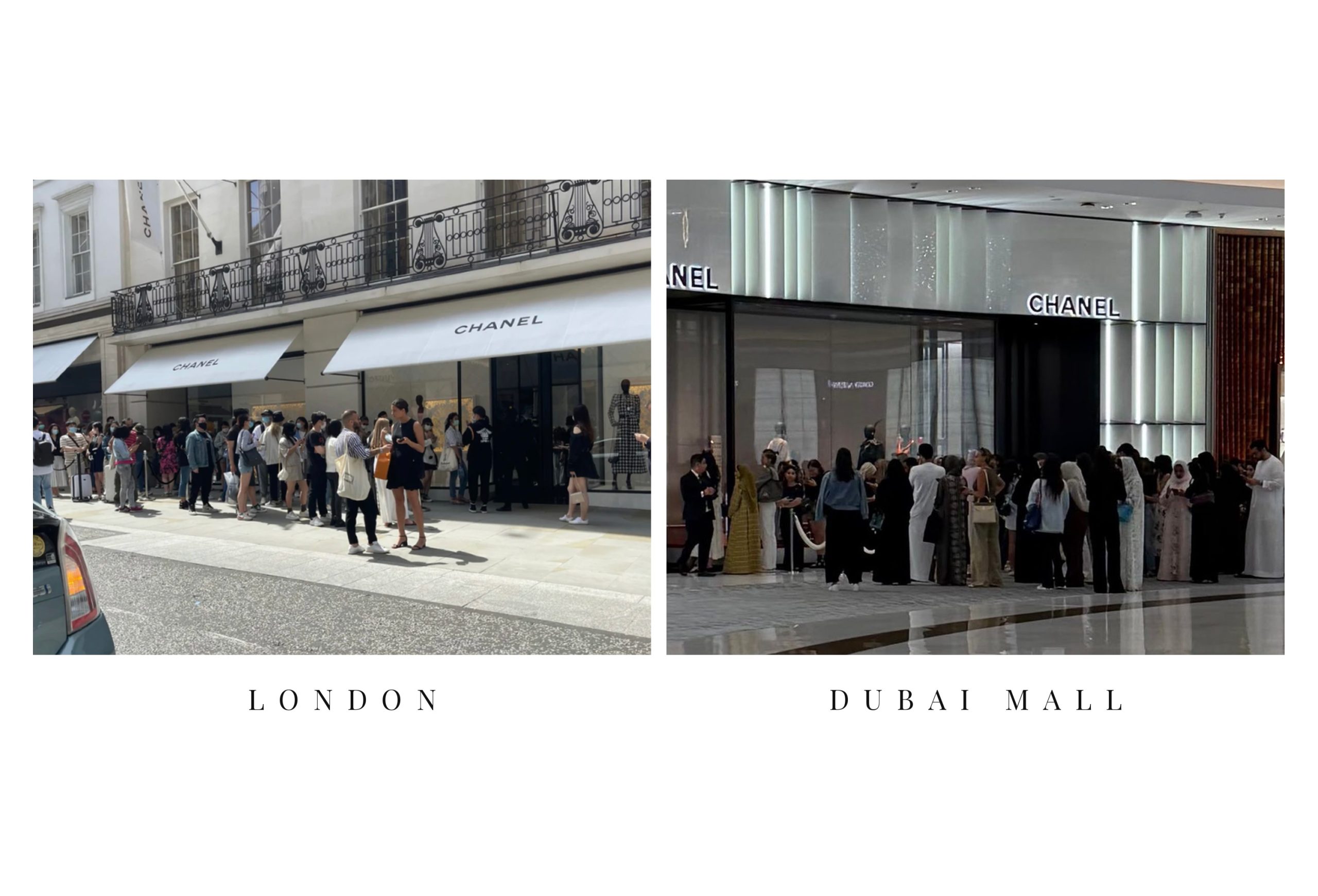
From London to Dubai, the queues looked the same: infinite. A scene the industry had quietly...


No comments yet.