


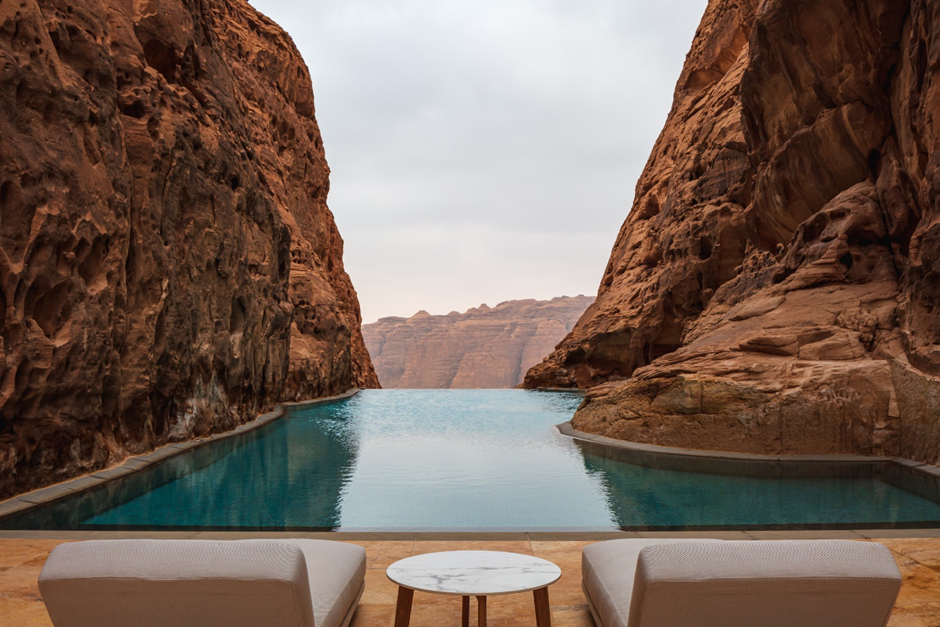
Banyan Tree Alula, Saudi Arabia
Gulf sovereigns are moving beyond capital deployment to cultural authorship — building a new era of luxury that fuses investment logic with identity, influence, and permanence.
This summer, Shamal Holding announced a partnership with Cheval Blanc — LVMH’s ultra-luxury hospitality brand — to open its first Maison in Dubai.
Set to debut in 2029 on Naïa Island, the project will feature 30 suites and 40 private villas, blending French craftsmanship with Gulf grandeur.
It’s more than another hotel launch.
It signals the Gulf’s next chapter in hospitality leadership — investing in-house to elevate a luxury offering that already outperforms global standards and, in doing so, reshaping the global map of prestige and power.
For decades, Gulf investors deployed capital into Western prestige assets — the Four Seasons George V in Paris, The Savoy in London, or global hotel groups through sovereign funds and royal family offices.
Today, Gulf capital is diversifying.
The same capital once parked in Mayfair is now building experiences in-house — from Cheval Blanc Dubai to Saudi Arabia’s Red Sea Global and AlUla, where heritage and hospitality merge to tell a new story of regional excellence.
PIF’s Adeera, its newly launched hospitality management arm, is developing Saudi hotel brands across segments from mid-range to ultra-luxury — part of a broader effort to create a unified national ecosystem for hospitality.¹
Meanwhile, Red Sea Global, also owned by the Public Investment Fund (PIF), is developing over 50 high-end resorts, including upcoming properties by Six Senses, Ritz-Carlton Reserve, and Rosewood — positioning Saudi Arabia as both investor and curator within global luxury tourism.²
As Abdulla Bin Habtoor, Chief Portfolio Management Officer at Shamal Holding, said when announcing the Cheval Blanc partnership:
“This collaboration underscores Dubai’s position as a world-leading luxury destination and reflects our commitment to shaping extraordinary experiences that celebrate our city’s spirit.”
These are strategic acts of cultural authorship. From AlUla’s sandstone-carved Rock Resort to Cheval Blanc Naïa, the Gulf is crafting experiences that merge heritage, nature, and innovation — defining a new chapter of experiential wealth.
The financial rationale is clear. With oil dependency gradually waning, Gulf sovereigns are reallocating capital toward tourism and luxury hospitality as long-term growth engines under Vision 2030.
But beneath the economics lies a deeper calculus — a shift from Return on Investment to Return on Identity.
Owning hotels in Paris once bought prestige. Building them at home builds permanence — and projects Arab culture onto the global stage.
This new luxury strategy isn’t about imitation. It’s about cultural self-definition — telling the region’s story through design, service, and experience — and, in the process, spreading Arab excellence and aesthetics across the world.
According to McKinsey & Company, the global luxury-tourism market is projected to grow from USD 239 billion in 2023 to USD 391 billion by 2028.
Within that picture, the GCC’s total tourism economy — spanning everything from mass travel to ultra-luxury — reached USD 247 billion in 2024 (a 32% rise since 2019) and is forecast to hit USD 371 billion by 2034, per WTTC.
While those figures include all tourism segments, the luxury tier — roughly 10% of global travel spend — is likely far higher in the Gulf, given its visitor profile.
In Dubai, the average daily spend per international visitor reached USD 1,300 in 2024 (Dubai DET), compared with a global average of USD 700 (WTTC).
Luxury dominates: 35–40% of Dubai’s hotel inventory is five-star or above (STR Global, Knight Frank).
No other region in the world has such a dense concentration of ultra-luxury hospitality.
That structural advantage explains why Gulf states are competing to become the epicenter of the UHNW travel economy — an economy set to reach approximately USD 182 billion by 2033, up from around USD 90 billion in 2024.³
This underscores why the Gulf’s luxury-hospitality expansion isn’t speculative — it’s riding a structural wave.
For finance leaders overseeing these projects, the pivot isn’t simply about deploying capital — it’s about mastering a new dimension of it: cultural capital.
Instead of tracking only revenue, the priority now is ensuring the region owns its stories, heritage, and global presence.
Every resort, museum, and branded destination becomes a manifestation of national identity — shared, experienced, and recognized globally.
The real return isn’t in occupancy rates — it’s in a rising sense of Arab culture resonating on the global stage.
With Style and Strategy,
Kahina
Footnotes
¹ Public Investment Fund (2024). “PIF launches hotel management company Adeera to develop distinct new Saudi hospitality brands.” pif.gov.sa
² HospitalityNet (2023). “Red Sea Global (RSG) — wholly owned by Saudi Arabia’s Public Investment Fund — developing 40–50 hotels including Six Senses, Ritz-Carlton Reserve, and Rosewood.” hospitalitynet.org
³ Growth Market Reports (2025). “Ultra-High-Net-Worth Travel Market Forecast 2025–2033.” growthmarketreports.com
 Capital Couture
The most valuable thing De Beers owns may be the one asset nobody in the room...
Capital Couture
Five years of cultural momentum, zero euros in profit. The house has no creative director, no...
Capital Couture
From London to Dubai, the queues looked the same: infinite. A scene the industry had quietly...



No comments yet.