


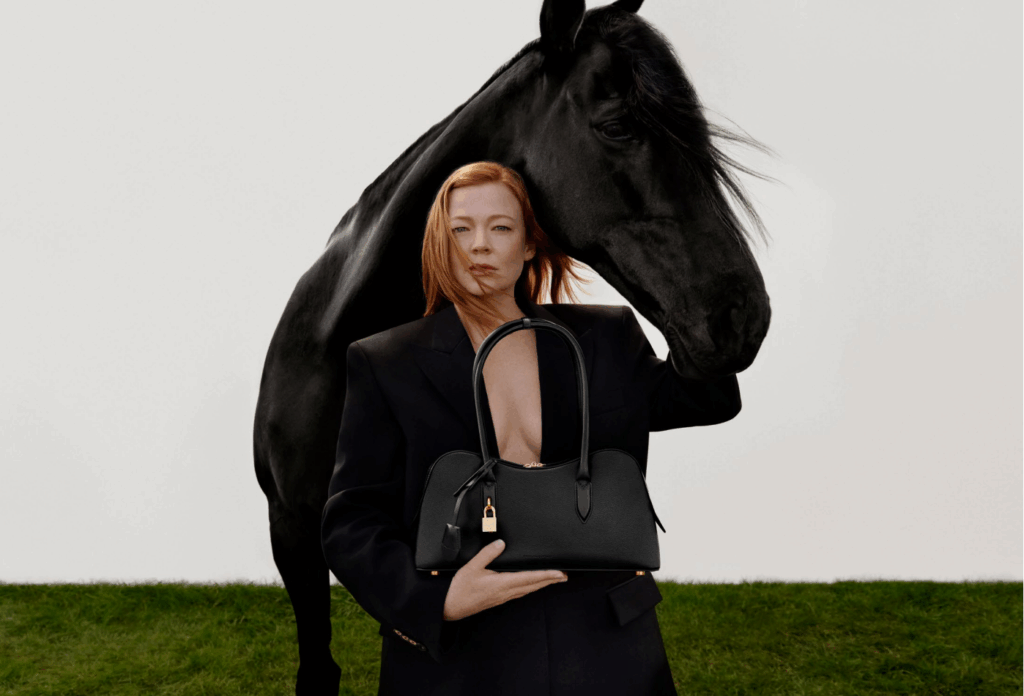
In June 2025, Hermès brought its equestrian heritage to Shanghai with the Au Galop! runway show—transporting its signature codes of leathercraft, discipline, and grace to a city more known for skyline than paddock. Saddle stitching, signature leather, and structured riding boots graced the sand-packed runway, a reminder that equestrian fashion isn’t tied to geography. It has evolved into a global code: one that signals heritage, control, and quiet authority.
Everyone knows Hermès began in 1837 as a harness and saddle-maker—its saddle stitch, bridle leather, and precision craftsmanship remain the foundation of the house’s identity.
Many of Hermès’ most iconic creations still echo that heritage:
But fewer know that Gucci’s equestrian DNA runs just as deep. Founded in 1921 in Florence, the house began by crafting saddles, bridles, and fine luggage for Italy’s riding elite. Its signature green-red-green web stripe drew inspiration from the girth straps that fasten a horse’s saddle, and in 1953 Aldo Gucci introduced the now-iconic Horsebit loafer — a symbol of understated power. Decades later, the brand reintroduced the Horsebit 1955 line, which quickly resonated with a new generation; analysts note it became one of Gen Z’s most coveted designs on Chinese platforms such as Xiaohongshu. ¹
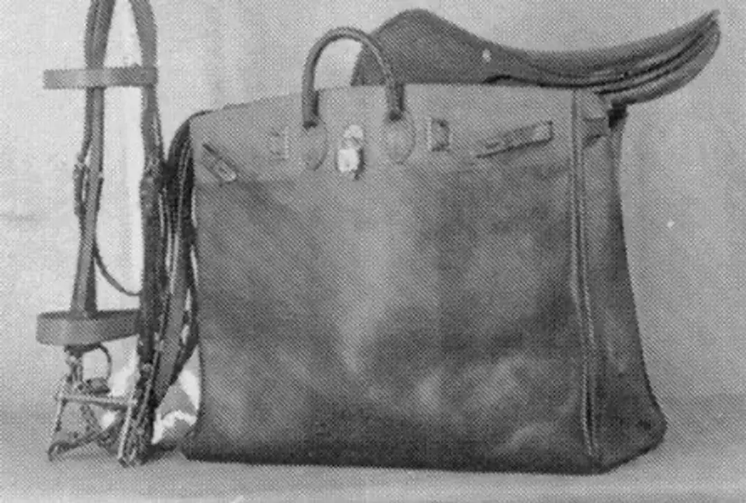
The Haut à Courroies bag | Source: LVBagaholi
Equestrian fashion never really left—but in recent years, it’s seen a renaissance. The rise of #OldMoney and #QuietLuxury on social media has brought back riding boots, saddle bags, and clean tailoring.
According to fashion media reports, “quiet luxury” has amassed over 38.5 billion views on TikTok, while brand tracking firms like Hypebeast and Edited note that “Old Money” and related terms have already logged hundreds of millions of views. Meanwhile, #horsegirl has scored over 23.6 billion views—with reports citing around 1.3 million posts and 14.4 billion views—a clear sign that equestrian aesthetics are riding a wave into the mainstream. What began as a functional uniform for riders has evolved into a global business code — one that luxury houses continue to reinterpret as a language of mastery and heritage. The aesthetic has become less about horses, and more about how we translate those codes into our daily wardrobes.
Long associated with European aristocracy—particularly in France and the UK—the horse has long stood as a symbol of lineage, prestige, and control. Riding was not just sport, but a marker of class and composure.
But interestingly, the fashion codes born from this heritage—structured tailoring, leather harnesses, and riding boots—have spread far beyond the paddock.
Today, equestrian style thrives even in cities with no stables at all—not as function, but as aspiration. The horse becomes a metaphor—for control, for discipline, and for refined power. Riding requires posture, strength, and restraint. So does real luxury.
Equestrian codes don’t just signal heritage—they embody a risk-averse luxury wardrobe strategy. Riding boots, structured blazers, saddle bags—these are seasonless, resale-friendly, and inheritance-worthy.
In the UK, Holland Cooper has built a £26 million business on tailoring, tweed, and riding trousers—with jackets under £900—proving that equestrian elegance can be both aspirational and attainable. (The Times, March 2023)
On Vestiaire Collective, Hermès riding boots can resell for up to three times their original retail price, reinforcing their status as fashion’s equivalent of blue-chip stock—holding value not only socially, but financially.
Stella McCartney’s Ryder bag, her latest it-piece, mirrors the elegant curve of a horse’s back — proof that equestrian codes still shape contemporary design. They endure because they embody the same virtues they were built for: strength, composure, and command.
In a market defined by constant reinvention, they remain the uniform of control.
With Style and Strategy,
Kahina
 Fashion Office
This week, LuxExperience’s shares jumped as much as 24% on its results. Group CEO Michael Kliger...
 Fashion Office
FT Luxury Summit with Elizabeth Paton and Cedric Charbit The most desirable house in fashion posted...
 Fashion Office
Chantilly 12.05.2026 C.F.O :Capital Fahion and Opinion Six panels. Four pillars of the luxury growth model...



No comments yet.